


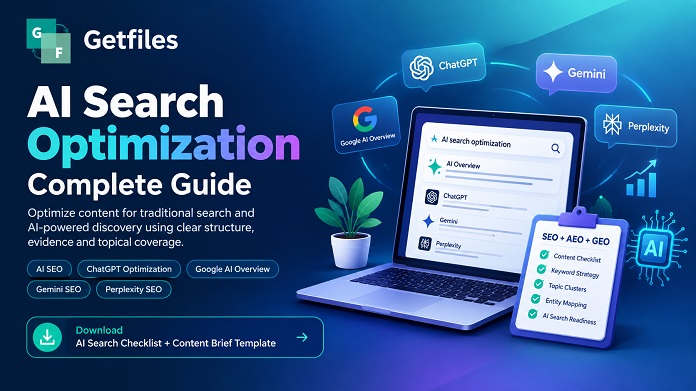
Search is changing.
Earlier, people mainly searched Google, opened a few websites, compared information, and selected an answer. Today, users can ask ChatGPT, Google AI Overviews, Gemini, or Perplexity and receive a summarized answer within seconds.
This change creates a new opportunity for website owners, bloggers, SEO professionals, and businesses.
You no longer need to optimize content only for traditional search rankings. You also need to make your content easy for AI systems to understand, trust, summarize, and recommend.
This is where AI search optimization becomes important.
In this guide, we will understand GEO, SEO vs AEO vs GEO, and keyword research for AI search, along with a practical strategy that you can implement on your own website.
What Is AI Search Optimization?
AI search optimization is the process of creating and structuring website content so that it can perform well in traditional search engines and become useful information for AI-powered search and answer systems.
The goal is not simply to rank for one keyword.
The bigger goal is to build content that provides:
- Clear answers
- Strong topical coverage
- Reliable information
- Supporting evidence
- Well-organized sections
- Relevant entities and concepts
- Natural language
- Useful examples
- Easy-to-understand explanations
For example, instead of creating an article only around the keyword “SEO tools”, you can create a comprehensive resource covering SEO tools, keyword research, technical audits, competitor analysis, content optimization, AI SEO, reporting, and practical use cases.
This gives both search engines and AI systems more context about your expertise.
What Is GEO?
GEO stands for Generative Engine Optimization.
It focuses on improving the visibility of your content in AI-generated answers and generative search experiences.
Traditional SEO asks: “How can I rank my webpage?”
GEO asks: “How can my information become a useful source for an AI-generated answer?”
This doesn’t mean traditional SEO is dead.
Instead, GEO works alongside SEO.
How GEO Works
AI systems need to understand information from different sources before generating answers. Content that is clear, well-structured, relevant, and supported by trustworthy information has a better chance of being useful to these systems.
For example, suppose you publish:
“Complete Guide to Technical SEO.”
A weak article may contain 800 words with general statements.
A stronger GEO-focused article might explain:
- What technical SEO means
- Crawlability
- Indexability
- XML sitemap
- Robots.txt
- Canonical URLs
- Core Web Vitals
- Structured data
- Internal linking
- Common technical SEO mistakes
- Practical implementation examples
Now the content provides much more context.
Important GEO Principles
When optimizing for generative search, focus on:
1. Clear structure
Use logical headings, short paragraphs, lists, tables, and direct answers.
2. Evidence
Support important claims with trustworthy sources, original research, examples, statistics, or practical experience.
3. Topical depth
Cover the main topic and closely related subtopics instead of repeating the same keyword.
4. Original value
Add your own examples, analysis, screenshots, experiments, case studies, or observations.
5. Entity understanding
Mention relevant concepts, tools, companies, technologies, and related entities naturally where appropriate.
6. Answer-first writing
Answer the user’s question clearly before adding deeper explanations.
SEO vs AEO vs GEO
SEO, AEO, and GEO are related, but their primary objectives are different.
| Strategy | Main Goal | Typical Platform |
|---|---|---|
| SEO | Rank webpages in search results | Google, Bing |
| AEO | Provide direct answers to questions | Search answer features, voice assistants |
| GEO | Increase visibility in generative AI answers | AI search and generative engines |
SEO – Search Engine Optimization
SEO focuses on improving a website’s visibility in traditional organic search.
Important areas include:
- Keyword research
- On-page SEO
- Technical SEO
- Internal linking
- Backlinks
- Content quality
- Search intent
- User experience
AEO – Answer Engine Optimization
AEO focuses on answering specific questions clearly.
For example:
Question: What is technical SEO?
AEO-friendly content should provide a direct answer:
Technical SEO is the process of improving a website’s technical structure so search engines can crawl, understand, and index its content efficiently.
After the direct answer, you can provide additional explanation.
GEO – Generative Engine Optimization
GEO focuses on making content useful for AI-generated discovery.
Instead of targeting only:
“SEO”
you may cover a broader topic ecosystem:
- SEO
- AI SEO
- AEO
- GEO
- AI search
- Google AI Overview
- ChatGPT optimization
- Gemini SEO
- Perplexity SEO
- Search intent
- Content authority
This creates stronger topical coverage.
The Smart Strategy
Don’t choose only one.
Use:
SEO + AEO + GEO
Think of them as three layers of the same content strategy.
SEO: Help search engines discover and rank you.
AEO: Help answer engines understand your answers.
GEO: Help generative systems understand and potentially reference your expertise.
Keyword Research for AI Search
Keyword research is still important in the AI-search era.
But the approach is changing.
Traditional keyword research often focuses on: Search volume + keyword difficulty + CPC
For AI search optimization, you should also consider: Intent + questions + entities + context + related topics + conversational queries
For example, your primary keyword might be:
AI search optimization
Related keywords could include:
- AI SEO
- ChatGPT optimization
- Google AI Overview
- Gemini SEO
- Perplexity SEO
But don’t stop here.
Find the questions people may ask around the topic.
Example Keyword Cluster
Primary Topic: AI Search Optimization
Supporting Topics:
- What is AI search optimization?
- What is GEO?
- SEO vs AEO vs GEO
- How does AI search work?
- How to optimize content for ChatGPT?
- How does Google AI Overview select information?
- How can businesses optimize for Gemini?
- What is Perplexity SEO?
- How to create AI-friendly content?
- How to improve topical authority?
This creates a topic cluster rather than a single-keyword article.
How to Perform AI-Focused Keyword Research
Step 1: Start With a Seed Keyword
Choose your main topic.
Example:
AI search optimization
Step 2: Find Related Keywords
Use SEO tools, Google suggestions, related searches, forums, and competitor research to discover related terms.
Look for variations such as:
- AI SEO
- AI search
- generative search
- GEO
- AEO
- AI content optimization
Step 3: Find Questions
Questions are extremely valuable for AI-focused content.
Search for:
- What is AI search optimization?
- How does GEO work?
- How do I optimize content for ChatGPT?
- How can I appear in Google AI Overview?
- Does SEO still work with AI search?
These questions can become H2 or H3 sections.
Step 4: Map Search Intent
Understand why someone is searching.
Common intents include:
Informational:
“What is GEO?”
Commercial:
“Best AI SEO tools”
Transactional:
“AI SEO software”
Navigational:
“Google AI Overview”
Your content should satisfy the actual intent instead of forcing keywords into paragraphs.
Step 5: Build a Topic Map
Create a list of the main topic, subtopics, related questions, entities, and supporting concepts.
This becomes your content brief.
How to Optimize Content for AI Search
Once keyword research is complete, create content that is genuinely useful.
Use Clear Headings
Instead of large blocks of text, organize the article with meaningful H2 and H3 headings.
Give Direct Answers
If your heading is:
What Is GEO?
Start with a concise definition before explaining the topic in detail.
Use Examples
AI systems and users both benefit from contextual examples.
Instead of saying: Create high-quality content.
Explain: If you are writing about technical SEO, explain crawlability, indexability, canonical URLs, XML sitemaps, structured data, and real implementation examples.
Add Original Information
Your strongest advantage is information that cannot easily be copied from hundreds of websites.
Consider adding:
- Original case studies
- Experiments
- Screenshots
- Data
- Expert opinions
- Customer questions
- Real implementation results
Strengthen Internal Linking
Connect related articles.
For example:
AI Search Optimization → SEO → Keyword Research → Technical SEO → AEO → GEO
This helps create a connected content ecosystem.
AI Search Optimization Checklist
Before publishing an article, ask:
- Is the main question answered clearly?
- Does the article match search intent?
- Is the primary keyword used naturally?
- Are related topics covered?
- Are important questions answered?
- Does the content provide original value?
- Are claims supported where necessary?
- Are headings descriptive?
- Are paragraphs easy to understand?
- Are internal links relevant?
- Is the author/business expertise clear?
- Can both humans and machines easily understand the content?
Download: AI Search Checklist + Content Brief Template
Creating AI-optimized content becomes much easier when you have a repeatable process.
Download the AI Search Checklist + Content Brief Template to plan your:
- Primary keyword
- Related keywords
- Search intent
- AI-search questions
- Topic clusters
- Content structure
- Supporting entities
- Internal links
- Evidence and sources
- Content optimization checklist
Instead of starting every article from zero, use the template to create a consistent workflow.
How GetFiles Can Help You Build a Bright Future in AI Innovation
The future of digital marketing is moving toward a combination of SEO, AI search, automation, content strategy, and practical technology skills. GetFiles is designed to help learners move beyond theoretical knowledge by providing practical learning resources, tutorials, downloadable materials, and implementation-focused content. Whether you want to learn SEO, website development, databases, digital marketing, or emerging AI-search strategies, GetFiles can become a practical learning platform where you can learn, implement, experiment, and build skills for the future of AI-driven digital innovation. The goal is simple: don’t just learn what technology is—learn how to use it to create real opportunities.
Final Thoughts
AI is changing how people discover information, but the fundamentals of good content haven’t disappeared.
People still need accurate information.
Search engines still need to understand websites.
AI systems still need useful sources.
The opportunity is to combine all three.
A modern content strategy should therefore focus on:
SEO for visibility + AEO for direct answers + GEO for generative discovery.
Start with strong keyword research. Understand the questions behind the keywords. Build comprehensive topical coverage. Provide evidence and original value. Structure your content clearly.
Most importantly, don’t create content only because an algorithm might like it.
Create content that solves the user’s problem better than the alternatives.
That is the foundation of sustainable search visibility—whether the user discovers your website through Google, an AI Overview, ChatGPT, Gemini, Perplexity, or another search experience.
Frequently Asked Questions
1. What is AI search optimization?
AI search optimization is the process of creating and structuring content so it can be easily understood and discovered through traditional search engines and AI-powered search or answer systems.
2. What is the difference between SEO and GEO?
SEO primarily focuses on improving visibility in traditional search engine results, while GEO focuses on optimizing information for visibility and usefulness within generative AI search experiences.
3. Is SEO still important after the growth of AI search?
Yes. SEO remains important because search engines still need to discover, crawl, understand, and evaluate webpages. AI search optimization should complement traditional SEO rather than completely replace it.
4. How can I optimize my content for ChatGPT, Gemini, and Perplexity?
Create clear, accurate, well-structured, comprehensive content. Answer questions directly, demonstrate expertise, provide evidence, cover related concepts, and add original information instead of simply repeating existing content.
5. What should I learn first: SEO, AEO, or GEO?
Start with SEO fundamentals, then learn AEO and GEO. A strong understanding of keywords, search intent, technical SEO, content structure, and authority gives you the foundation needed to optimize for modern AI-powered search.


