


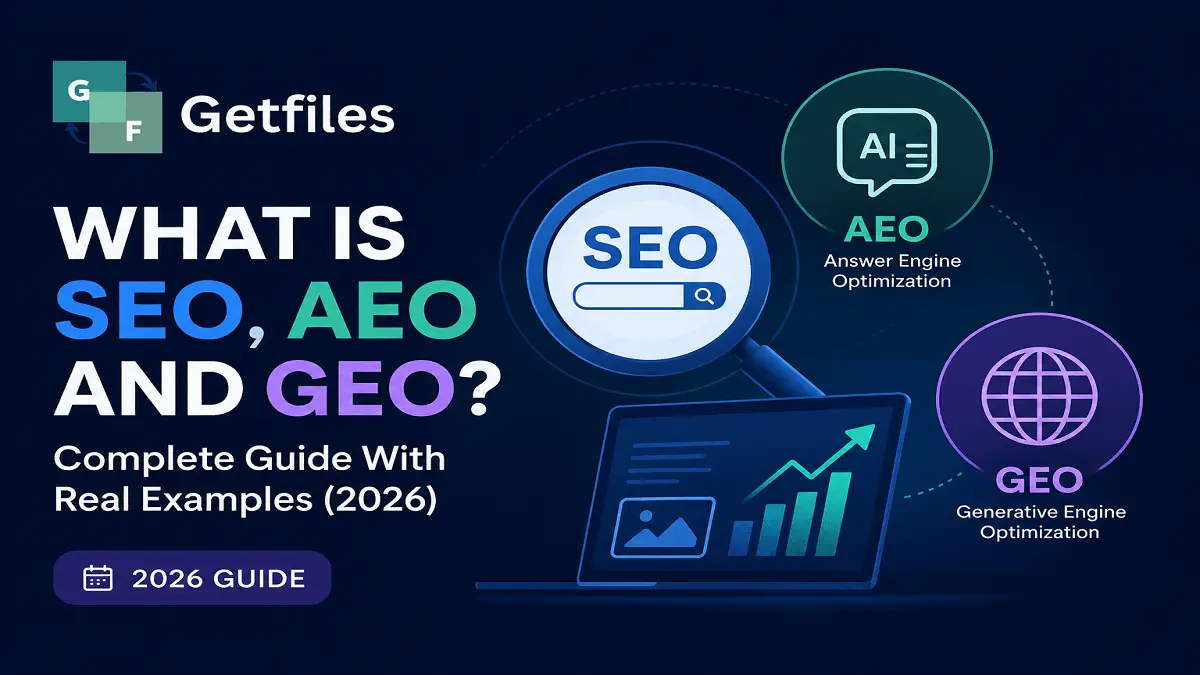
Digital marketing is changing very fast. Few years ago, ranking on Google was enough to get traffic. But now people are asking questions directly to AI tools like ChatGPT, Perplexity AI, Google Gemini and voice assistants.
That means websites now need more than traditional Search Engine Optimization.
Today, businesses also need:
- Search Engine Optimization (SEO)
- Answer Engine Optimization (AEO)
- Generative Engine Optimization (GEO)
If you understand these 3 things properly, your website can get traffic not only from Google search results but also from AI generated answers.
In this complete guide, we will understand:
What is SEO in Digital Marketing?
Search Engine Optimization Explained
Search Engine Optimization, mostly called SEO, is the process of improving a website so it can rank higher on search engines like Google and Bing.
The main goal of SEO is simple:
Get more organic traffic without paying for ads.
For example:
Imagine you have a website that provides free source code downloads like GetFiles.co.in.
If someone searches:
“portfolio website source code free download”
and your blog appears on first page, you can get visitors, downloads and even customers.
That is SEO.
Types of SEO
1. On-Page SEO
This includes:
- keyword optimization
- headings
- internal linking
- image alt tags
- content quality
- meta title and description
Example:
Using keyword:
“Best JavaScript Projects with Source Code”
inside:
- title
- URL
- headings
- content naturally
2. Off-Page SEO
This means improving authority using:
- backlinks
- guest posts
- brand mentions
- social sharing
Example:
If another tech website links your article, Google thinks your content is trusted.
3. Technical SEO
Technical SEO focuses on:
- website speed
- mobile responsiveness
- indexing
- schema markup
- crawlability
Example:
If your site loads in 2 seconds instead of 8 seconds, rankings can improve.
Why SEO is Important in 2026
SEO is still one of the biggest traffic sources because billions of searches happen every single day.
But there is one major change.
People now get direct answers from AI.
This is where AEO and GEO become important.
What is AEO in SEO?
What is Answer Engine Optimization?
AEO stands for Answer Engine Optimization.
It means optimizing content so search engines and AI assistants can directly pick your answer.
Instead of ranking only webpages, modern systems try to provide:
- direct answers
- snippets
- AI summaries
- voice search responses
This is why Answer Engine Optimization tactics are becoming very important.
Real Example of AEO
Suppose someone searches:
“What is SEO?”
Google may directly show:
- featured snippet
- AI overview
- voice assistant answer
If your content is properly optimized, your website can become that answer source.
That is AEO.
Important AEO Strategies
1. Use Question-Based Headings
Example:
- What is SEO in digital marketing?
- What is Generative Engine Optimization?
- Difference between SEO and GEO
This helps AI understand your content structure.
2. Write Clear Answers
Bad example:
SEO is kind of important for many things and websites.
Good example:
SEO is the process of optimizing a website to improve organic visibility in search engines.
Simple and direct answers perform better.
3. Add FAQs
FAQ sections help search engines understand:
- intent
- context
- direct answers
This is why FAQ schema is powerful for AEO.
4. Use Structured Data
Schema markup helps search engines understand:
- articles
- FAQs
- products
- reviews
- organization details
Why Zero-Click Searches Matter – Zero-Click Search Optimization 2026
A zero-click search happens when users get the answer without clicking any website.
Examples:
- AI Overviews
- featured snippets
- voice answers
- instant summaries
This means websites must optimize for visibility even when users don’t click.
Many website owners are scared because clicks reduce, but smart marketers use this as branding opportunity.
If AI repeatedly mentions your website, your authority grows.
What is GEO in SEO?
What is Generative Engine Optimization?
Generative Engine Optimization (GEO) is the process of optimizing content for AI-powered search engines and generative AI tools.
Unlike traditional SEO, GEO focuses on helping AI systems:
- understand your content
- trust your website
- cite your information
- use your content in generated responses
Modern AI systems include:
- ChatGPT
- Perplexity AI
- Claude AI
- Google Gemini
Difference Between SEO and GEO
GEO vs Traditional SEO
Traditional SEO mainly focused on:
- keywords
- backlinks
- ranking position
But GEO focuses more on:
- semantic meaning
- entities
- expertise
- trust
- contextual relationships
This is why Entity-based SEO guide concepts are becoming popular.
What is Entity-Based SEO?
An entity is a clearly identifiable thing:
- person
- brand
- place
- company
- topic
For example:
- OpenAI
- ChatGPT
AI systems understand entities better than keywords alone.
Earlier SEO was:
Repeat keyword many times
Modern GEO is:
Build topical authority around entities and context
How to do GEO in SEO
1. Create Topical Authority
Instead of writing random blogs, create connected content clusters.
Example:
If your niche is web development:
Write:
- HTML tutorials
- CSS guides
- JavaScript projects
- React tutorials
- source code articles
AI systems start seeing your site as trusted expert.
2. Use Semantic Keywords
Instead of repeating one keyword 50 times, use related terms naturally.
For example:
If your topic is SEO: also use:
- search rankings
- organic traffic
- indexing
- crawlability
- SERP
- featured snippets
3. Add Author Expertise
AI systems trust real expertise more.
Include:
- author bio
- experience
- examples
- case studies
4. Improve EEAT
Google and AI systems prefer:
- Experience
- Expertise
- Authority
- Trustworthiness
If your content feels copied or robotic, GEO performance becomes weak.
5. Use Conversational Content
AI tools prefer human style content.
Instead of:
“SEO is the optimization methodology…”
Write:
“SEO helps your website appear higher on Google so more people can find you.”
Simple language works better.
How to Get Cited by ChatGPT and Perplexity
This is one of the most important AI search engine optimization strategy in 2026.
Step 1: Publish Original Insights
AI tools love unique information.
Instead of copying:
“SEO is important”
Add:
- statistics
- experiments
- comparisons
- personal insights
Step 2: Write Structured Content
Use:
- headings
- bullet points
- FAQs
- tables
- summaries
Structured content is easier for AI parsing.
Step 3: Build Brand Mentions
If many websites mention your brand, AI systems notice authority.
Example:
- Reddit discussions
- blogs
- YouTube mentions
- Quora answers
Step 4: Optimize for Citations
AI tools prefer:
- trustworthy websites
- fact-based writing
- updated content
- transparent sources
Optimizing Content for AI Search Engines
Use Natural Human Language
AI systems understand conversational queries.
People now search:
“Which is better SEO or GEO?”
instead of:
“SEO GEO difference”
Add Contextual Depth
Thin content usually fails.
AI engines prefer:
- detailed explanations
- examples
- topical coverage
- related subtopics
Keep Content Updated
Outdated articles lose trust quickly.
Especially in:
- SEO
- AI
- technology
- digital marketing
AI Search Engine Optimization Strategy for 2026
Focus on Multi-Platform Visibility
Your content should appear on:
- Bing
- AI chatbots
- YouTube
- forums
- social media
Build Personal Brand
AI systems increasingly recognize creators and experts.
If your name appears consistently with one topic, authority improves.
Optimize for Voice Search
Voice searches are growing fast.
Example:
“Hey Google, what is Generative Engine Optimization?”
Your content should answer naturally.
Use FAQ Sections
AI tools love FAQ formatting because answers are direct and easy to extract.
SEO + AEO + GEO Together
The future is not:
SEO OR GEO
The future is:
SEO + AEO + GEO together.
Because:
- SEO brings rankings
- AEO brings answer visibility
- GEO brings AI citations
Smart marketers combine all three.
Example of SEO vs AEO vs GEO
SEO Example
Keyword:
“best free coding websites”
Goal:
Rank on Google first page.
AEO Example
Question:
“Which website provides free coding projects?”
Goal:
Become featured snippet or AI overview answer.
GEO Example
AI Prompt:
“Suggest websites for free source code downloads”
Goal:
Get cited inside AI generated response.
Common GEO Mistakes
1. Keyword Stuffing
Repeating keywords unnaturally hurts trust.
2. Thin AI Content
Low quality AI-generated articles usually fail long-term.
Human editing matters a lot.
3. No Structure
Large paragraphs without headings confuse AI parsing.
4. Ignoring Entities
Modern AI search relies heavily on entity recognition.
Future of SEO and GEO
The future of search is becoming:
- conversational
- AI-powered
- personalized
Traditional blue-link search is slowly changing.
People increasingly trust:
- AI assistants
- answer engines
- conversational search
But websites with real expertise will still win.
Final Thoughts
Search is changing faster than ever before.
Earlier, ranking on Google was enough. But now AI tools like ChatGPT and Perplexity AI are becoming new discovery platforms.
That’s why understanding:
- Search Engine Optimization
- Answer Engine Optimization tactics
- Generative Engine Optimization (GEO)
is very important for every blogger, marketer and business owner.
If you want success in 2026, don’t optimize only for search engines.
Optimize for humans + AI together.
Because future traffic will come from both.
FAQ of SEO, AEO and GEO
What kind of content performs best in Generative Engine Optimization?
The content that performs best in Generative Engine Optimization (GEO) is usually content that feels genuinely useful, deeply informative, and easy for AI systems to understand. Modern AI search engines like ChatGPT, Perplexity AI, and Google Gemini do not only look for keywords anymore. They try to understand meaning, context, trust, and expertise behind the content.
In older SEO strategies, many websites used keyword stuffing to rank higher. But GEO works differently. AI systems prefer content that answers real user intent naturally. That means if somebody searches “How to do GEO in SEO,” the AI wants to show content that explains:
- what GEO actually means,
- why it matters,
- how it works,
- real examples,
- mistakes to avoid,
- and future trends.
Thin articles with 500 words usually do not perform well in GEO because they lack contextual depth. AI systems are trained to identify whether a piece of content provides complete understanding or just surface-level information.
The best performing GEO content usually includes:
- detailed explanations,
- real-world examples,
- FAQs,
- statistics,
- comparisons,
- structured headings,
- conversational writing,
- semantic keywords,
- and strong entity signals.
For example, an article about “Search Engine Optimization” should naturally mention related entities like:
- ChatGPT
- OpenAI
- Microsoft
This helps AI understand the topical relationship of the article.
Another important thing is originality. AI engines increasingly prefer content that adds unique insights instead of repeating what already exists online. If your article includes your own experience, research, opinions, mini case studies, screenshots, or practical examples, the chances of being cited become much higher.
Human-style writing also matters a lot. Overly robotic AI-generated content often lacks emotional flow and contextual clarity. Content written in a natural tone with slight imperfections sometimes performs surprisingly better because it feels authentic.
Long-form content generally works better for GEO because it provides broader topical authority. Articles between 1500–3000 words often perform stronger than short posts, especially when the topic is educational or informational.
Content that usually performs best in GEO includes:
- tutorials,
- complete guides,
- industry explainers,
- research-backed articles,
- comparison posts,
- FAQ pages,
- case studies,
- and expert opinion blogs.
In simple words, GEO rewards content that genuinely teaches something valuable instead of only trying to rank.
Why are “zero-click searches” important for AEO and GEO?
Zero-click searches are becoming one of the biggest changes in digital marketing and search behavior. A zero-click search happens when a user gets the answer directly on the search page or inside an AI-generated response without clicking any website.
This trend is growing rapidly because modern users want faster answers. Instead of opening 10 websites, people now prefer instant summaries from AI systems and search engines.
For example, when someone asks:
“What is SEO in digital marketing?”
Google may show:
- AI Overview,
- featured snippet,
- knowledge panel,
- or direct answer box.
Similarly, AI tools like ChatGPT or Perplexity AI generate direct responses instantly.
This creates a major shift in how websites get visibility.
Earlier SEO focused mainly on:
getting clicks.
But AEO and GEO focus more on:
becoming the trusted answer source.
That is a huge difference.
Many website owners panic because zero-click searches may reduce website traffic. But actually, they also create new opportunities. If your website becomes the source cited by AI engines repeatedly, your brand authority grows significantly.
Imagine this example:
A user asks:
“Best free websites for coding projects.”
If AI tools mention your platform like GetFiles.co.in inside the generated answer, users start recognizing your brand even if they don’t immediately click.
Over time this builds:
- trust,
- visibility,
- authority,
- and brand recall.
Zero-click search optimization 2026 is not about fighting AI answers. It is about positioning your content inside those answers.
This is exactly why Answer Engine Optimization tactics are becoming essential.
To optimize for zero-click searches:
- write direct answers,
- use question-based headings,
- add FAQ sections,
- use schema markup,
- structure content clearly,
- and provide concise summaries before deeper explanations.
AI systems usually extract:
- short definitions,
- bullet points,
- quick summaries,
- and well-structured answers.
Another important reason zero-click searches matter is voice search growth. Smart assistants like Siri, Alexa, and Google Assistant often read only one answer aloud. If your content becomes that answer source, your visibility becomes extremely powerful.
In the future, many users may never even visit traditional search result pages. They will simply ask AI systems conversational questions.
That’s why websites now need:
- SEO for rankings,
- AEO for answer extraction,
- and GEO for AI citations.
Businesses ignoring zero-click optimization today may struggle heavily in upcoming years.
Does GEO replace traditional SEO?
No, Generative Engine Optimization (GEO) does not replace traditional Search Engine Optimization (SEO). Instead, GEO works together with SEO as an evolution of modern search behavior.
Many people think AI search engines will completely kill SEO, but that is not fully true. Search engines and AI systems still need websites, content creators, publishers, and experts to gather information from. Without quality websites, AI systems would have nothing valuable to cite or summarize.
Traditional SEO is still extremely important because it helps:
- webpages rank,
- search engines crawl content,
- users discover websites,
- and businesses gain organic traffic.
However, GEO adds another layer on top of SEO.
Earlier the process was simple:
- optimize keyword,
- rank on Google,
- get clicks.
But now search behavior is changing.
Users increasingly ask AI tools:
- “What’s the best laptop for coding?”
- “Explain SEO simply.”
- “Best AI tools for students.”
- “Which hosting is best for WordPress?”
Instead of showing only blue links, AI systems generate direct conversational answers.
This is where GEO becomes important.
GEO focuses on:
- AI readability,
- entity recognition,
- semantic understanding,
- contextual trust,
- and citation optimization.
Traditional SEO mainly measures:
- rankings,
- backlinks,
- click-through rate,
- and keyword performance.
GEO measures:
- AI visibility,
- citation frequency,
- topical authority,
- and entity trust signals.
The smartest digital marketers in 2026 are not choosing between SEO and GEO. They combine both.
For example:
A well-optimized article should:
- rank on Google through SEO,
- appear in featured snippets through AEO,
- and get cited by AI systems through GEO.
That is the ideal strategy.
You can think about GEO like this:
Traditional SEO+AI Optimization=Modern GEO Strategy
Traditional\ SEO + AI\ Optimization = Modern\ GEO\ Strategy
Traditional SEO+AI Optimization=Modern GEO Strategy
If your website ignores traditional SEO completely, search engines may struggle to index and trust your pages properly. On the other hand, if you ignore GEO, your content may slowly disappear from AI-generated discovery systems.
In reality, GEO is not replacing SEO. GEO is expanding SEO into the AI era.
The future belongs to websites that optimize for:
- search engines,
- answer engines,
- AI systems,
- and human readers together.
What is the main difference between SEO and GEO?
The main difference between SEO and GEO is the target system they optimize for.
Search Engine Optimization (SEO) mainly focuses on improving visibility in traditional search engines like Google and Bing.
Generative Engine Optimization (GEO) focuses on improving visibility inside AI-generated responses from platforms like:
- ChatGPT
- Perplexity AI
- Claude AI
- Google Gemini
Traditional SEO is mostly about ranking webpages higher in search results pages.
GEO is about making your content understandable, trustworthy, and citable for AI systems.
For example:
In SEO, success usually means:
- ranking #1 on Google,
- getting more clicks,
- improving CTR,
- increasing organic traffic.
In GEO, success means:
- getting mentioned in AI answers,
- becoming a trusted citation source,
- increasing brand authority,
- and improving AI visibility.
SEO mainly depends on:
- keywords,
- backlinks,
- page speed,
- technical optimization,
- and search intent.
GEO depends more on:
- entities,
- semantic meaning,
- contextual relationships,
- author expertise,
- structured content,
- and topical authority.
Another major difference is how users interact with results.
Traditional SEO users click links and visit websites.
GEO users often stay inside AI conversations and consume summarized answers directly.
This is why “zero-click search optimization 2026” is becoming such an important topic.
Here’s a very simple comparison:
One more important difference is content style.
SEO content earlier sometimes worked even with keyword-heavy writing.
But GEO content must feel:
- natural,
- human,
- contextual,
- and deeply informative.
AI systems are much better at detecting shallow or low-quality content.
That’s why modern websites need:
- high-quality educational content,
- semantic optimization,
- structured formatting,
- FAQ sections,
- and topical depth.
The future of digital marketing is not SEO vs GEO.
The future is:
SEO + AEO + GEO together working as one complete strategy.


